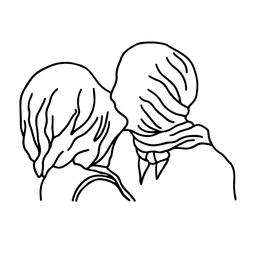
When lovers lie on a bed, and embrace each other so closely that the arms and thighs of the one are encircled by the arms and thighs of the other, and are, as it were, rubbing up against them, this is known as Tila-Tandulaka, an embrace like the mixture of sesamum seed with rice.
—Kama Sutra
The Kama Sutra, the ancient Indian book of mystical eros, begins with a discussion on how to live a balanced human life by first discovering one's own destiny (Dharma), accepting one's responsibilities and securing the means of living a full and responsible life (Artha) alongside a meaningful understanding of our own desires and pleasures (Kama), and sexuality in general, in the way we live and think.
To pursue purely aesthetic or mystical experiences; to be singularly intent on crystallising an identity, to doggedly pursue autonomy and selfhood is as detrimental to our wellbeing as reckless, abject sensualism.
The ancient traditions reveal what we have forgotten: that the split between body and spirit is not wisdom but wound. Our culture's obsessive yet unsatisfying relationship with sex reveals not an excess of desire but a deficiency of depth. Whether we pursue pleasure compulsively or renounce it virtuously, we remain trapped in the same neurosis — treating sex as a special category rather than recognising it as the soul's own language.
The dizzy heights of sexual experiences take us deep down into the body. The ecstasy of touch and the sights and sounds of sex can put us into a kind of trance — an altered state of consciousness where reality and fantasy merge [and imagination reigns supreme]
In sex, an inner life of erotic imagery and vivid fantasy is consummated with a real person. In sex we may unconsciously reveal many truths about our partner, ourselves, our passions, and the meaning of life itself — for the challenges sex offers are revealing precisely because our deepest tendencies are crossed or satisfied, and in being crossed or satisfied, they accomplish a revelation. They show us what we are.
Heraclitus said ethos anthropos daimon — character is fate, or better: a person's character is their guiding spirit. In ordinary life we hide our character even from ourselves. We perform. We edit. We present the curated self. But in sexual trance the editing faculty softens, the curator steps away from the gallery, and what rises to the surface is unscripted — the actual texture of our longing, our fears, our strange allegiances.
Fantasies about being tied up aren't necessarily masochistic, but a need to relinquish control when waking life demands staunch discipline. Fantasies about being watched don't necessarily imply exhibitionist tendencies but a need to have our bodies, our feelings, our desires, witnessed. The fantasy doesn't diagnose pathology; it reveals tendency. The very word tendency (from the Latin tendens) means a stretching toward, an aiming at something. It shows the soul's direction of travel.
In any of the strong feelings that conjure lust, anger, or fear, there is always one part of the mind enjoying and another suffering. And it is important to give voice to the part that suffers, to let it speak before we move on. Making space for whatever feelings we have to be there allows us to become larger than them — not by rising above them, but by stretching to include them. Fantasies, like dreams, expand, enhance, exaggerate, or distort reality. Shedding inhibitions, the unashamed unconscious swiftly moves in unaccustomed ways and means taking us further and faster in the direction it needs to go. Like dreams, they hold contradictions without resolving them, entertaining opposing truths simultaneously.
Therapy can free a person from emotional entanglements, but it does not generally provide a path into the larger sense of aliveness that arises when old scripts and storylines fall away entirely — that moment of shift and opening when you are, briefly, nobody's history. For the therapeutic approach asks why am I like this? — a question that reaches backward. The sexual fantasy elicits self-knowledge of a very different kind, the phenomenological kind: not cause but texture. This is what I'm like. This is what moves me. This is the shape of my desire.
The remedy is neither indulgence nor abstinence but presence: an unhurried, contemplative attention that allows sex to become what it has always wanted to be — not a release of pressure but a revelation of who we are.